:: View topic - How about this
Posts: 34 · 34 posts
unknownTue Sep 04, 2012 3:44 pm
I thought about this idea for a while but never had the chance to try until past weekend.
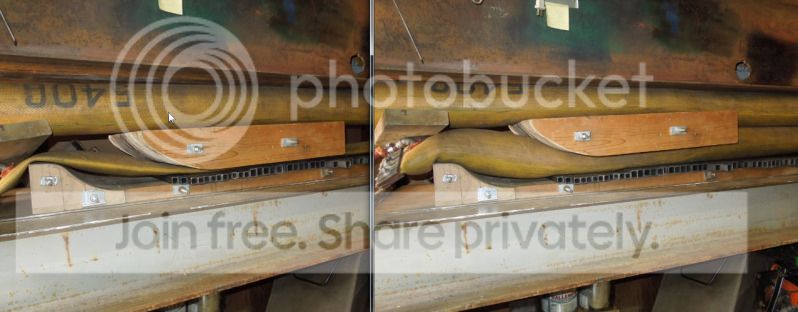
How about use firehose above the top mold as a filler also it should work to create adjustable opening for cassette. Basically my idea if top firehose inflated to higher pressure in comparison to main firehose and prevent it from full inflation . Unfortunately yesterday I had only 2 clamped and connected to air so I had not the complete test just proof of concept. It worked. Top firehose inflated at 70 PSI and lower one at 40 psi. At this point I'm not really sure what pressure would be at laminate.
What you guys think about it?
unknownTue Sep 04, 2012 3:54 pm
I think I've seen some one place the hose between the press frame and the top form. But no hose on the bottom. Placing the hose on the top of the form could work if you have very close tolerances between the top/bottom form.
One draw back is when the hose deflates you'll need some heavy-duty springs or something heavy duty to lift up the form so you can get the skis out.
unknownTue Sep 04, 2012 4:14 pm
unknownTue Sep 04, 2012 4:25 pm
I'm playing to get big trampoline with A LOT of springs because my cattracks have a lot of weight already. If this is not enough I can get specialty springs very compact and very strong. At that point I think trampoline springs should work.
unknownTue Sep 04, 2012 6:44 pm
Good thinking, if you ask me.
Pressure at the laminate would be calculated using 40psi in your calculations, regardless of pressure of the top bladder.
unknownWed Sep 05, 2012 12:35 am
That's what I thought. One thing I am not really sure is when main firehose get inflated to 40 PSI top one got compressed a little known that I have is I increased pressure from 60 to 70 PSI. Here I could see main hose get squeezed again. Also for 2 main firehose is needed at least three on the top
unknownThu Sep 06, 2012 4:29 pm
Somebody set me straight here... Wouldn't the two hoses equal out to the same pressure? If the top one is a higher pressure it's going to press down until the bottom hose is at the same pressure? I guess maybe the contact area is the difference. The forces have to be identical.
unknownThu Sep 06, 2012 5:27 pm
One way to tell is install two gauges. The lower pressure of the two is transferred to the cat track.
unknownThu Sep 06, 2012 6:20 pm
Looks like twice as much to go wrong, to me anyway.
unknownFri Sep 07, 2012 7:43 am
What can go wrong?
unknownFri Sep 07, 2012 7:47 am
I did install two valves instead of 2 gauges . I'm not a scientist are you sure about pressure?
unknownFri Sep 07, 2012 4:11 pm
Maybe a better question might be what CAN'T go wrong ;-)
unknown
It doesn't matter what question is better.
I was hoping you share some of your thoughts on those can/can't go wrong
unknown
i think he's talking about the not yet known problems Jan refers to as "it's always something"
unknown
Yea, that's pretty much it. There are twice as many bladders, air lines and regulators coupled with additional monitoring is all. What could possibly go wrong?
It's been said on here before...simpler is probably better.
unknown
I don't see this idea to be complicated. As far hardware all it needed 2' of air hose, one valve, 1 (T). Altogether no more than $15. I think possible issues you mentioned are minor. It definitely simpler compared to making hydraulic lifters for upper I-beams to create adjustable cavity for cassette.
unknownFri Sep 07, 2012 11:08 pm
Yeah, I think you're right, but the pressure on the lower gauge would still be the accurate pressure.
unknownSat Sep 08, 2012 7:57 am
I guess the question is if a bladder is at 100 psi and you apply a 50psi bladder against it does the 100psi bladder yield at all or does it effectively act as a solid surface until its pressure is exceeded.
I think DBS is right that the pressure registering on the gauge is what the layup is experiencing (with cat track and surface area needing to be accounted for).
I think the real test would be to inflate the upper bladder and isolate the air in it. Then inflate the lower bladder to the desired pressure and see if the pressure in the upper bladder has increased.
It's a good science question regardless!
unknownSat Sep 08, 2012 1:38 pm
It's the force, not pressure, you have to think about. The forces are equal everywhere, otherwise it would either fly into space, or go through the earth.
If the top hose is at 100psi and the bottom hose is at 40 psi, then the bottom hose has exactly 2.5 times the contact area of the top hose.
So you could use the 100psi hose to figure out your pressing force, you just have to consider the contact area of that hose.
unknownSat Sep 08, 2012 7:18 pm
In my first experiment top hose taking twice as much vertical space and was almost fully inflated to hose diameter of 5 inches when bottom hose got inflated to 40 PSI top one which was about 65 at the time got squeezed a little, then I increase the pressure in top host to little over 70 PSI.
Also will have to be 3 hoses on the top if to have top hose inflated to full diameter
unknownSun Sep 09, 2012 3:08 am
I did install two valves instead of 2 gauges . I'm not a scientist are you sure about pressure?[/quote]
Pretty sure. Think about whats going on, your higher pressure hose is on top acting like cribbing to your top mold. Your bottom hose is doing the pressing of the skis. Now if your bottom hose has more pressure than the top hose the pressing force will be from the top hose.
unknownSun Sep 09, 2012 7:20 am
NO. Wrong. Forget top hose vs bottom hose, it doesn't matter.
Both hoses exert the EXACT same FORCE on the ski. The bottom hose is pressing the ski. The top hose is also pressing the ski. Any difference in pressure is only due to difference in contact area of the hose. If both hoses have the same contact area, they will both end up with the same pressure.
Remember what doughboy said, what you care about is force (or pressure) at the laminate, so you've got to figure out contact area of the bottom hose to the cattrack, or the top hose to the top mold (since the number will be the same), then figure out your contact area of the laminate to the cat track.
http://www.grc.nasa.gov/WWW/k-12/airplane/newton.html
unknownMon Sep 10, 2012 12:34 am
Vive la vacuum!
unknownMon Sep 10, 2012 2:37 am
The forces are all equal but the pressures can be different!
unknownMon Sep 10, 2012 7:50 am
Yeah but... so?
Sorry I know I'm distracting from the main point of this thread. I think it's a fine idea. People just keep saying things like the higher pressure hose can be considered rigid until the other hose is higher, etc, which just isn't true.
What I would do is inflate both hoses at the same time, and put the bottom hose at the pressure you'd press with normally, and don't even worry about the pressure in the upper hose.
unknownMon Sep 10, 2012 12:02 pm
I was agreeing with you as your link and reminder of newton's laws made me think about it properly.
(thinking about it of course the upper hose has to change shape when the lower hose is inflated otherwise there is no surface area created that experiences/exerts the force. What I am struggling to understand is if the air in the upper bag is isolated and psi measured on a gauge, given that the surface area of the hose(the actual internal surface area of the hose not anything to do with the size of its contact with the press) remains the same does it's change in shape actually change the psi of the air in the hose?)
On a side note: The big trouble is we look at our psi gauges which give us an easy number to quote. But really we should be measuring our hose contact area so we can use the psi to say how many pounds we are applying to the cat track. And then measuring our board's surface area to then say what pressure (pounds per unit of area) we are applying to the board itself during pressing.
How do you accurately measure/estimate hose contact area?
Vive le vacuum indeed
unknownMon Sep 10, 2012 2:59 pm
Just stirring the pot
It's a bit chicken or egg, but the pressures in the hoses are the variable we can control so the pressure in the hoses determines the contact areas rather than the contact area determining the pressure in the hose
If both hoses have the same pressure the contact area will be equal. As, if the contact area is equal the pressures in the hoses must be equal
unknown
Touche! Chicken and the egg indeed!
As for the question about does the isolated air in the hose change pressure, even with a constant internal surface area, sure. When you squeeze the hose, you are decreasing the volume. Pressure varies inversely with the volume (PV=nRT!). Assuming constant temperature of course. We're also heating these things, so that increases the pressure as well.
How do I accurately measure mine? I don't... 50psi at the regulator = some amount of squeezy, and after 60 minutes in some amount of squeezy, a ski pops out.
unknown
[quote="twizzstyle"]
unknown
That's how mine works too!
unknown
That's how my press works too
Not to flog a dead horse but when you squeeze the round hose and cause it to change shape does the volume actually change? When it squeezes it gets wider, but not as tall so the overall volume (cross sectional area x length) may not be different. The amount of air in the hose stays constant and therefore if the volume changes so does the pressure.
unknown
Time for maths! (slow day at work...)
Let's take a 5" diameter hose, fully inflated, perfect circle. This has a cross sectional area of 19.63in^2
Lets squish that into a rectangle where the width is double the height. With the same outer circumference, this is a rectangle 5.23" wide and 2.62" tall. This has an area of 13.7in^2.
The pressure would go up by about 1.4!
(ok back to work
)
unknownMon Sep 10, 2012 5:31 pm
thanks
By the way to the OP. I think also it looks like a good idea that gives you easier press loading without having to use hydraulics/jacks etc. You would just have to make sure that your upper bladders all inflated at the same rate and maybe some kind of constraint on the top mold so that it moves only up and down when pressure is applied to it from above and below. If the upper and lower hoses on one side inflated more rapidly than the other size it might spit your top mold out the side like a slippery bar of soap!